3 min read
The best design tool is not the one that does everything
It doesn’t exist. And if it did, designers wouldn’t have jobs anymore.
 Adam Bárta
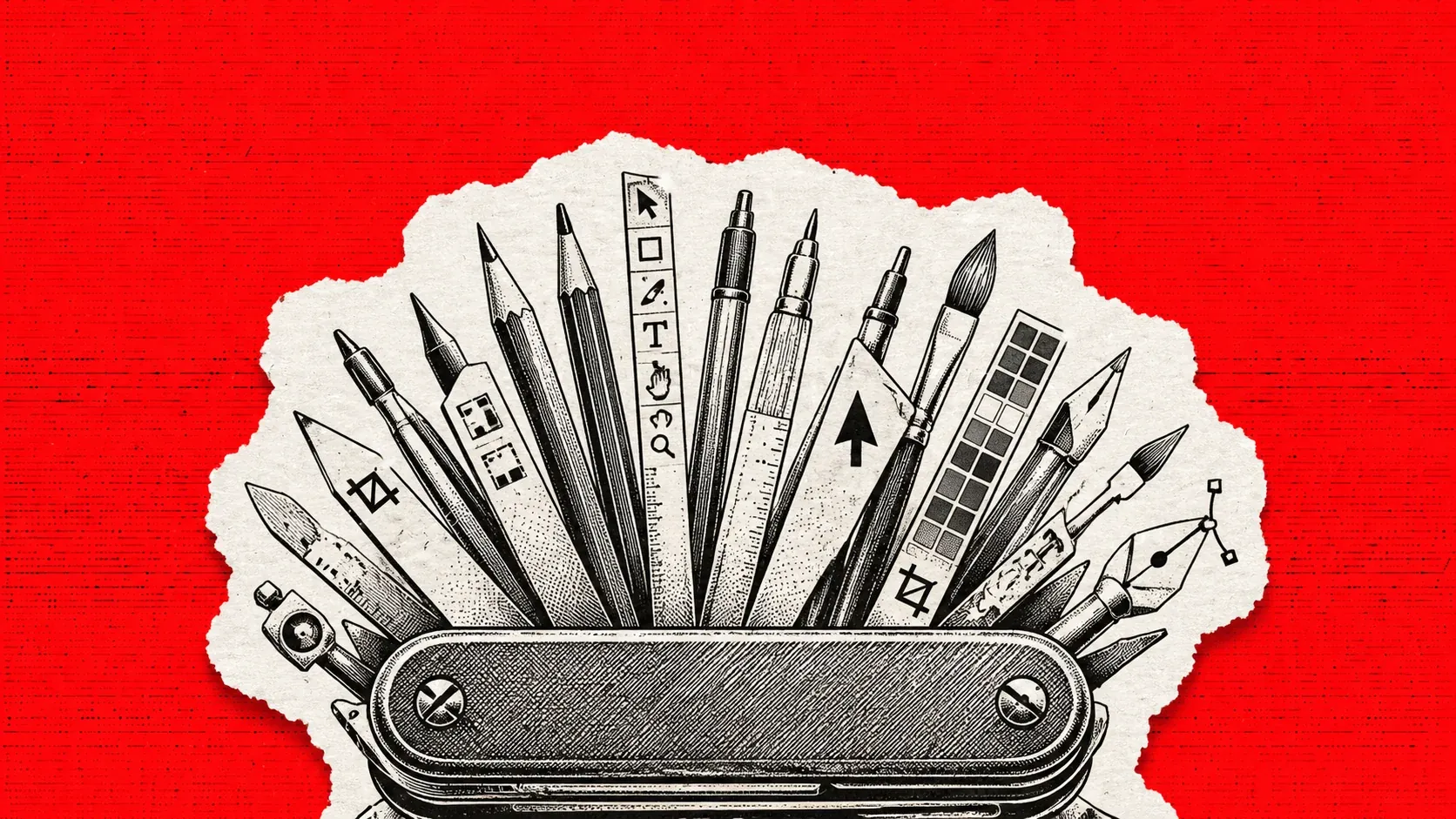
In the age of AI, most of us are chasing the wrong thing.
One tool for images, code, layouts, and assets that works with AI, which designs everything for you.
The pitch sounds great. But in practice, it doesn’t work
Everyone ends up with an output that looks like everyone else’s output — because everyone is using the same everything tool, with the same defaults, and no real direction.
Not to mention that right now, all these tools suck. No matter how flashy the trailers.
The problem isn’t the tools. The problem is the assumption that one tool can replace a design process.
Design has never been one thing. It’s direction, execution, refinement, and judgment layered on top of each other. No single tool does all of that well. The ones that try usually do none of it well.
My actual stack
I’ve spent the past two months testing every AI tool and workflow I could find. This is what I've settled on for now:
- Flora— complex image workflows
- Midjourney — general imagery
- Figma — design direction and sketching
- Affinity — cleaning up AI output
- Codex — custom components and animations
- Framer — connects it all on the site
- Notion — holds the context
Seven tools. Each trusted for a specific part of the process. None of them doing everything.
The keyword is “trusted”
Not the one with the best demo. Not the one that launched last week.
Trusted means I know what it does. I know its limits. And I know when to reach for something else instead.
The more we work with a tool, the better we understand where it breaks.
Most designers are still in the evaluation phase — running tests, watching tutorials, practicing their skills. Take your time to really understand the tools you are using.
What does this change for designers?
The range of what we can explore in a single project.
Before AI, committing to a visual direction meant committing to the hours required to execute it. We’d pick one direction, build it out, and find out later whether it was right. If it wasn’t, we’d already spent the budget finding out.
Now I can test three directions before I decide on one. 3D, realistic photography, drawn illustrations… everything is game now.
The palette of what’s possible on a real project timeline has genuinely expanded.
What holds it together
Context (and us).
My taste, my project details, my decisions — all of it lives in text files (in my case in Notion). That’s the place that keeps every tool pointed in the same direction.
As designers, we notice things the AI doesn’t. We have opinions about spacing, about brand feel, about what fits this client and what doesn’t. That judgment has to live somewhere.
The AI handles execution. We still direct it.
We don’t need to redesign our whole process
Despite what every new San Francisco YC-funded founder is telling you, we don't need to reinvent our whole design flow. We need a small, capable set of tools that we understand.
And we need to constantly look for new ones that could enable better ways to work.
There will never be one tool that does it all (and does it well).